

If you're seriously considering bringing a sauna into your home, you've probably had this conversation — with a friend, a trainer, or just yourself: "What's the difference between a sauna and a steam room, and does it actually matter?"
It matters. Not because one feels better than the other — that's personal preference — but because they produce meaningfully different physiological outcomes. And if you're making a deliberate investment in your long-term health, knowing which one the research actually supports is worth your time.
This is that breakdown. Direct, evidence-based, and written for someone who doesn't need the basics explained.
The Core Difference
Sauna operates at 150°F to 200°F with low humidity. Steam room operates at 110°F to 120°F with humidity at close to 100%. The mechanisms are different, the physiological demands are different, and the research behind them is not equal in depth or consistency.
That temperature gap is larger than it looks. It's not just a matter of comfort — it determines the magnitude of your body's physiological response. Core temperature elevation, cardiovascular demand, heat shock protein activation, and sweat output all scale with heat intensity. Everything else in this comparison flows from that single variable.
Cardiovascular Health
Sauna wins — decisively.
The most comprehensive body of evidence on heat therapy and cardiovascular health comes from long-term Finnish research tracking thousands of sauna users over decades. The findings are consistent and significant: regular sauna use is associated with reduced risk of cardiovascular disease, lower resting blood pressure, improved heart rate variability, and reduced risk of fatal cardiac events.
One landmark study followed over 2,000 men for more than 20 years and found that those who used a sauna four to seven times per week had dramatically lower rates of sudden cardiac death than those who used it once a week. The mechanism mirrors aerobic exercise — repeated high-heat exposure forces the cardiovascular system to adapt. Heart rate rises, vessels dilate, cardiac output increases. Over time, the heart becomes measurably more efficient.
The dose-response relationship in this research is worth paying attention to. It's not just that sauna users had better outcomes — it's that more frequent sauna users had significantly better outcomes than less frequent users. Frequency compounds. That matters when you're deciding between gym access and home ownership.
Steam rooms show some promising short-term blood pressure data. But the scale, duration, and consistency of the research simply doesn't exist for steam the way it does for sauna. If cardiovascular health is part of why you're making this investment, the evidence points one direction.
Muscle Recovery
Tie — but the mechanism matters depending on what you're optimizing for.
Both deliver real recovery benefits. The difference is in what each one does and when.
Sauna's advantage is temperature-driven. High dry heat at 150–200°F triggers heat shock protein production — molecular compounds that support cellular repair, reduce inflammation, and protect muscle tissue against stress. The higher the core temperature, the stronger the stimulus. For athletes doing serious training volume, this cellular-level response is a meaningful differentiator that accumulates over time.
Steam's advantage is in immediate soreness relief. Moist heat penetrates tissue differently, and some research suggests steam may be more effective at reducing acute muscle soreness in the hours immediately following training. The lower temperature also allows longer sessions, which means more time in a parasympathetic recovery state for those who find the intensity of dry sauna difficult to sustain.
The honest answer: if you want the cellular repair response associated with heat shock protein activation, dry sauna has the edge. If you want immediate soreness relief after a hard session, steam is genuinely competitive. For most serious users, the deciding factor is which one they'll build a consistent habit around — and consistency is what produces lasting results.
Longevity and Long-Term Health
Sauna wins — and this is the category where the evidence is most compelling.
The longevity data on sauna use is among the most persuasive in the wellness space and worth understanding in detail before you make a decision. Multiple long-term studies have linked regular sauna use to reduced risk of dementia, Alzheimer's disease, all-cause mortality, and cardiovascular-related death.
The pattern is dose-dependent and consistent across studies. Frequency matters more than session length. Users who sauna four or more times per week show significantly stronger associations with positive long-term health outcomes than those who go once a week. The implication for home ownership is direct — frictionless access to your own sauna, on your schedule, is the single most effective way to hit the frequency the research associates with meaningful benefit.
This research is specific to traditional high-heat sauna. It has not been replicated for steam rooms at the same scale or over the same time periods. That's not a dismissal of steam — it's an honest statement about where the evidence stands in 2026. If you're evaluating this as a long-term investment in health span — not just wellness — the research base for sauna is substantially deeper and more consistent.
Stress Reduction and Mental Health
Tie — both are genuinely effective, and the difference is experiential.
High heat triggers endorphin release and shifts the nervous system from sympathetic (fight or flight) to parasympathetic (rest and digest). Reduced cortisol, improved mood, better sleep quality — these outcomes are well-documented and common to both formats.
Where they diverge is in the nature of the experience itself. Sauna's intensity produces what many regular users describe as a post-session euphoria — a clarity and physical lightness that's difficult to replicate through other means. The effort required to sit in 180°F heat for 20 minutes produces a reward response that mirrors the psychological benefits of hard physical training.
Steam produces a gentler, more enveloping relaxation response. Some users find it more meditative precisely because it's less demanding. Both are legitimate outcomes. The question worth asking is which experience you'll build a sustainable habit around — because regularity is what determines whether heat therapy actually transforms your health, or just occasionally improves your afternoon.
Respiratory Health
Steam room wins — and that's the honest answer.
Moist heat at close to 100% humidity opens airways, loosens mucus, and clears congestion in ways that dry sauna doesn't replicate at the same level. For anyone dealing with chronic sinus conditions, asthma, post-training respiratory congestion, or seasonal allergies, steam room sessions provide direct and noticeable relief.
Saunas offer some respiratory benefit — particularly when löyly is used and water is poured over hot rocks to generate brief steam — but it's not the same sustained effect as a dedicated steam environment. If respiratory health is your primary goal, steam room is the more targeted tool. For every other category on this list, sauna leads.
Skin Health
Steam room short-term. Sauna long-term.
Steam's direct moisture contact hydrates skin immediately — the effect is noticeable the moment you step out. For people with dry skin or those who prioritize the immediate post-session feel, that's a real advantage worth acknowledging.
Sauna improves skin through a fundamentally different mechanism. Increased circulation delivers more blood and nutrients to skin tissue. Intense sweating flushes impurities from pores at a depth that topical products can't reach. And consistent, long-term sauna use is associated with collagen support and improved skin elasticity over time.
Short-term, steam may feel better on the skin. Long-term, consistent sauna use produces more structural improvement. For buyers thinking about this as a daily practice rather than an occasional indulgence, the long-term picture matters more.
The Scorecard
| Category | Winner |
|---|---|
| Cardiovascular health | Sauna |
| Muscle recovery | Tie |
| Longevity and long-term health | Sauna |
| Stress reduction | Tie |
| Respiratory health | Steam room |
| Skin health (short-term) | Steam room |
| Skin health (long-term) | Sauna |
| Heat intensity and physiological stimulus | Sauna |
Sauna wins four categories outright, ties two, and loses two. Steam room wins where moist heat has a genuine biological advantage — respiratory and immediate skin hydration. Everywhere else, and across the deepest body of research available, sauna leads.
Why Temperature Is the Variable That Matters Most
The research associated with sauna's cardiovascular and longevity outcomes is based on traditional high-heat sessions — temperatures consistently above 170°F. That threshold matters because it's where cardiovascular demand, heat shock protein activation, and core temperature elevation reach levels that drive meaningful, lasting physiological adaptation.
This is the distinction most buyers miss when evaluating options. A sauna that runs at 140°F is not producing the same stimulus as one that runs at 200°F. The mechanism is similar — heat exposure — but the magnitude of the physiological response is categorically different. A car doing 40 mph and a car doing 80 mph are both moving. They are not producing the same outcome.
If you're making a serious investment in heat therapy, the temperature ceiling of your sauna is the most important specification on the page. Everything else — materials, design, portability — matters after that.
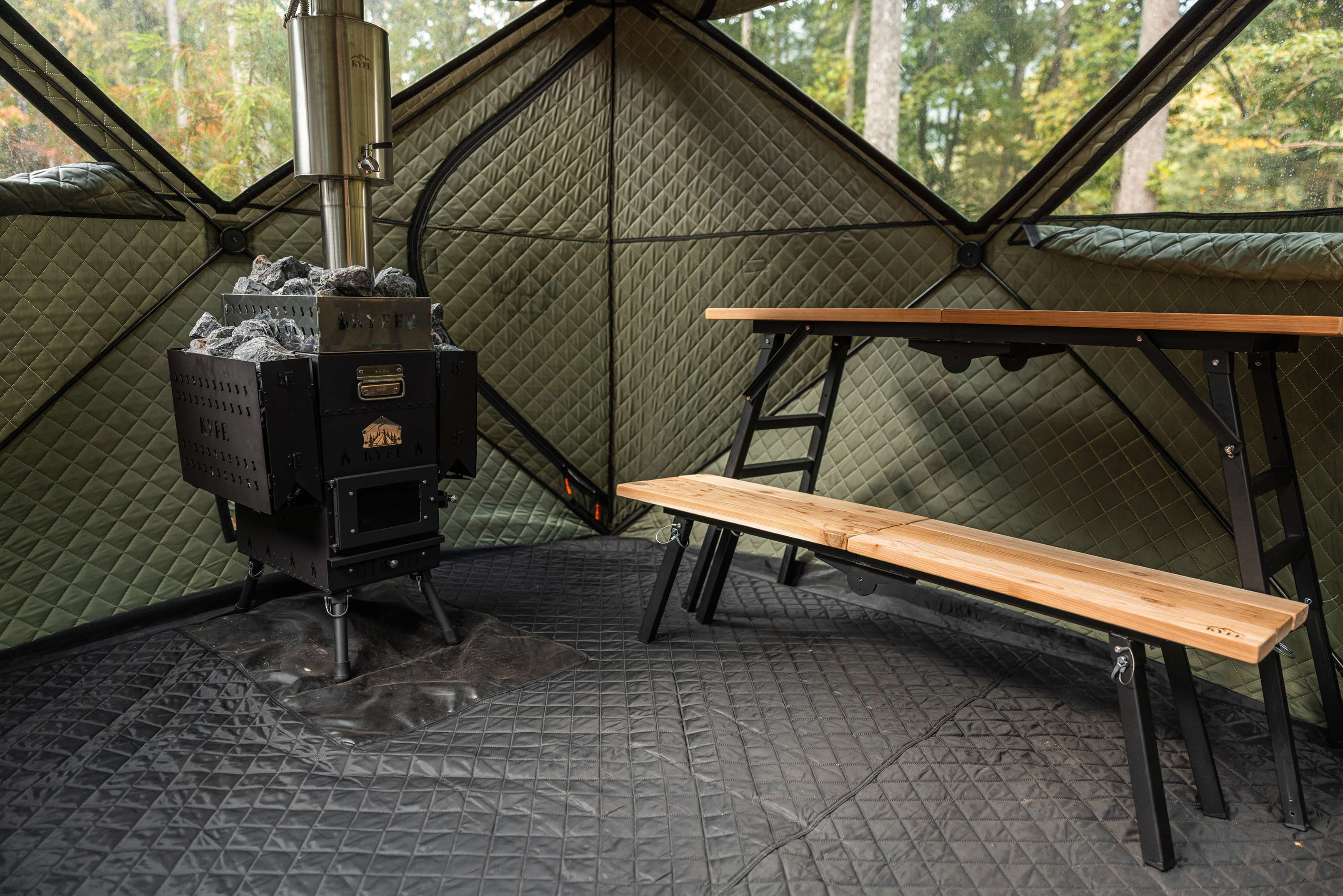
The Kyfe Portable Sauna Tent reaches 200°F in under 30 minutes using a wood-fired stove with real sauna rocks. That's the high end of what traditional sauna research is based on — delivered in a format that sets up in 15 minutes, requires no electricity, and goes wherever you need it to go.
The Case for Ownership Over Gym Access
One detail in the research that changes the calculation for serious buyers: the strongest health associations in sauna studies are linked to frequency, not session length. Using a sauna four or more times per week produces significantly better outcomes than once-a-week use across every major category — cardiovascular, longevity, stress reduction.
That finding makes the gym sauna a fundamentally different product than a home sauna. A gym sauna requires scheduling around availability, other members, operating hours, cleanliness, and the general friction of a shared space. You use it when it's convenient, not when your body needs it. A home sauna removes every one of those variables. You use it after training. You use it on a Tuesday evening when you're stressed. You use it four times a week because there's nothing stopping you.
The frequency data is one of the most compelling arguments for ownership — and the reason the upfront cost of a quality home sauna should be evaluated against years of consistent use, not a single session. Amortized over daily use, the economics of ownership become straightforward quickly.
You can read more about what consistent sauna use does to long-term health in our posts on how sauna affects metabolism and what saunas are actually used for.
What to Look for When Choosing a Sauna
If you've decided sauna is the right investment, a few criteria separate the options worth considering from the ones that aren't.
Temperature ceiling first. As covered above, the research is based on high heat. Look for units that reliably reach and sustain above 170°F. Get specific numbers, not marketing ranges.
Heat source matters. Wood-fired saunas with real sauna rocks produce the traditional dry heat the research is based on. Electric options can reach sufficient temperatures but require a power source and produce a different experience. Infrared operates on a different mechanism entirely at lower temperatures.
EMF exposure. Wood-fired saunas produce zero EMF emissions — the heat source is wood and stone. For daily users thinking about long-term exposure, that's a variable worth factoring in.
Portability vs. permanence. Permanent installations require dedicated space, permits in some jurisdictions, and significant upfront infrastructure cost. Portable wood-fired options like the Kyfe deliver equivalent heat performance with the flexibility to place them anywhere outdoors — and pack away when not in use.
Total cost of ownership. Factor in installation costs, electrical requirements, and long-term maintenance alongside sticker price. A portable wood-fired sauna with no electrical requirements and no installation cost is a different financial calculation than a permanent cabin that needs a dedicated circuit and professional setup.
The Bottom Line
Steam rooms are effective — particularly for respiratory health and immediate skin hydration. This isn't a case where one option is worthless and the other is perfect. But as a long-term health investment, evaluated against the depth of available research and the physiological outcomes that matter most to serious buyers, sauna wins clearly.
The cardiovascular evidence is stronger. The longevity data is deeper. The temperature-driven stimulus is more demanding. The frequency data makes ownership more logical than gym access. And the benefits compound over time in a way that rewards consistency above everything else.
If you're ready to bring that experience home — on your schedule, at the temperature the research is based on, without compromising on authenticity — the Kyfe Portable Sauna Tent is built exactly for that. Wood-fired heat to 200°F. Real sauna rocks. No electricity required. Sets up in 15 minutes and goes anywhere.
Free cold plunge included with every order. 60-day returns. Ships in 1–2 days.
FAQs
Can I use both a sauna and a steam room? Yes — they're not mutually exclusive. Some people use steam rooms for respiratory or skin-focused sessions and saunas for recovery and cardiovascular work. They serve different purposes effectively when used with clear goals in mind.
How often should I use a sauna for real health benefits? The research shows the strongest associations at four or more sessions per week. Two to three sessions per week still produces meaningful benefits and is a reasonable starting point. The data is consistent — frequency matters more than session length.
Is sauna safe to use every day? Most healthy adults tolerate daily sauna use well. Consult a physician if you have cardiovascular conditions, are pregnant, or are managing a chronic health condition before starting a daily routine. Hydration before and after every session is non-negotiable.
Does sauna help with weight loss? Sauna supports weight management through improved metabolism, cardiovascular conditioning, and the caloric demand of the heat response over time. It is not a primary fat loss tool and should not be positioned as one — but regular use as part of an active lifestyle contributes meaningfully to overall metabolic health. We cover this in detail in our post on how sauna affects metabolism.
What temperature should a sauna be for real health benefits? The research on cardiovascular health, heat shock proteins, and longevity is based on temperatures consistently above 170°F. The Kyfe reaches 200°F — the high end of what traditional sauna research is based on — putting it squarely in the range where those benefits are most strongly supported by available evidence.
What is the difference between a wood-fired sauna and an infrared sauna? Wood-fired sauna heats the air around you to high temperatures using a stove and sauna rocks, producing the same type of heat exposure the Finnish longevity research is based on. Infrared sauna uses light waves to heat the body directly at lower ambient temperatures. Both have real benefits — but they are different mechanisms, different experiences, and different temperature profiles. If you want the experience and research base of traditional sauna, wood-fired is the answer.




Why the Kyfe Portable Sauna Tent Is the Best Wood-Fired Sauna Kit of 2026
Wood-Fired Sauna vs Electric Sauna: Why the Heat Source You Choose Changes Everything