


Starting a sauna practice is one of the best wellness decisions you can make. The research on regular sauna use — cardiovascular health, stress reduction, muscle recovery, longevity — is compelling and consistent. But the gap between knowing sauna is beneficial and knowing how to actually build a sustainable routine is where most beginners get stuck.
This guide closes that gap. It covers everything you need to start safely, progress intelligently, and build a sauna practice that compounds over months and years — not just feels good for a few sessions before fading out.
If you own a Kyfe, this guide is written specifically for wood-fired sauna use at temperatures of 160–200°F. The protocols here are based on what that heat actually does to your body — not generic advice recycled from infrared sauna brands operating at half the temperature.
Why Beginners Need a Different Approach
Experienced sauna users can walk into 190°F heat, stay for 20 minutes, and feel great. Beginners who try the same thing often feel dizzy, uncomfortable, or put off the practice entirely. That's not a sign that sauna isn't for them — it's a sign that heat acclimation is real and matters.
Your body adapts to heat stress progressively, the same way it adapts to physical training. Cardiovascular efficiency improves. Plasma volume increases. Sweat response becomes more efficient. Heat shock protein production accelerates. These adaptations make every subsequent session more comfortable and more beneficial — but they take time to develop.
The beginner who builds gradually over 8–12 weeks develops a different relationship with heat than one who pushes too hard early and burns out. Patience in the first month pays compounding dividends for years.
Before Your First Session: What to Know
Before you step into the Kyfe for the first time, a few fundamentals that will make every session safer and more effective.
Hydration is the most important preparation. You will lose between 0.5 and 1 liter of fluid per 15-minute sauna session at high temperatures. Most of that is water and electrolytes — sodium, potassium, magnesium. Drink 16–24oz of water in the hour before your session. Have water and electrolytes ready for immediately after. Do not enter a sauna dehydrated — lightheadedness, nausea, and premature exit are almost always caused by insufficient pre-session hydration.
Eat lightly before. Avoid heavy meals in the 1–2 hours before a session. A light snack is fine. Entering the sauna with a full stomach is uncomfortable and diverts blood flow away from the peripheral circulation the heat is trying to drive.
Know your exit signals. The sauna is a controlled stress environment. Your body will tell you when it's had enough. Learn to recognize the signals: lightheadedness, nausea, heart rate that feels uncomfortable rather than elevated-but-manageable, or a sudden desire to leave. These are instructions, not suggestions. Exit immediately, cool down, rehydrate. There is nothing to prove by staying longer than your body is ready for.
Consult your physician first if you have any cardiovascular conditions, are pregnant, or are managing a chronic health condition. Sauna is safe for most healthy adults. It is not appropriate for everyone in every situation.
The 12-Week Beginner Protocol
This is the core of this guide — a progressive, week-by-week structure that builds heat tolerance safely and develops the habits that make sauna a sustainable long-term practice.
Weeks 1–2: Introduction Phase
Goal: Get comfortable with the heat. Learn your body's signals. Build the habit of showing up.
Temperature: 150–165°F — let the fire settle to a comfortable heat rather than pushing to maximum Session length: 8–10 minutes per round Rounds per session: 1 round only Sessions per week: 2
Your only job in weeks one and two is to get familiar. Notice how the heat feels on your skin, how your breathing changes, how your heart rate climbs. Sit on the lower bench where temperatures are slightly cooler. Don't force löyly on your first session — let the dry heat do the work. Exit before you feel you need to.
After each session, cool down gently — a walk outside, a cool shower, or simply sitting in fresh air. Rehydrate immediately. Journal how you feel if that's helpful — many beginners are surprised by the post-session clarity they notice even in early sessions.
By the end of week two, two sessions at 8–10 minutes should feel manageable and enjoyable, not challenging. If it still feels overwhelming, stay in this phase for another week before progressing.
Weeks 3–4: Building Phase
Goal: Extend session length and introduce löyly.
Temperature: 165–175°F Session length: 12–15 minutes per round Rounds per session: 1–2 rounds with 5-minute cooling between Sessions per week: 2–3
In weeks three and four you're extending the session and introducing the löyly experience. Start with a single conservative pour — a third of a ladle — and observe the response. The hiss, the rising steam, the wave of enveloping warmth. Take your time developing your pouring technique. Read more about getting this right in our complete guide to getting the perfect löyly.
If two rounds feel comfortable by the end of week four, you're ahead of schedule. Some beginners take longer to build to multi-round sessions and that's completely normal. The adaptation is happening regardless of whether it feels dramatic.
Weeks 5–6: Progression Phase
Goal: Increase frequency and begin exploring higher temperatures.
Temperature: 175–185°F Session length: 15 minutes per round Rounds per session: 2 rounds Sessions per week: 3
By week five, your cardiovascular system has started adapting to regular heat exposure. Sessions should feel noticeably more comfortable than they did in week one. This is the acclimation dividend — the same temperature that felt intense in week one feels manageable now because your body has adapted.
In weeks five and six, focus on the quality of the session rather than the quantity. Two clean 15-minute rounds with good löyly, proper cooling between rounds, and intentional post-session recovery produce better outcomes than longer sessions done carelessly.
This is also the phase where beginners typically start noticing the health benefits most clearly — improved sleep, reduced post-training soreness, better stress management. The benefits of regular sauna use are well-documented in our post on what saunas are actually used for.
Weeks 7–8: Consolidation Phase
Goal: Establish three sessions per week as a non-negotiable habit.
Temperature: 180–190°F Session length: 15–20 minutes per round Rounds per session: 2–3 rounds Sessions per week: 3
Weeks seven and eight are about consolidation — turning what has been a developing practice into a genuine routine. Three sessions per week is the target. The research on sauna frequency consistently shows that three-plus sessions per week is where meaningful cardiovascular and longevity associations become most pronounced.
At this point, session structure becomes more intentional. A typical three-round session looks like:
Round 1: 12–15 minutes at 175–180°F — opening the body, gentle löyly, acclimatizing Round 2: 15–20 minutes at 185–190°F — the main event, more active löyly, deepest sweat Round 3: 10 minutes at whatever temperature the stove holds — meditative, minimal löyly, closing the session
Cool between rounds. Hydrate throughout. Exit the Kyfe and sit in fresh air or use your cold plunge between rounds if you have one.
Weeks 9–10: Intensity Phase
Goal: Reach full operating temperatures and three to four sessions per week.
Temperature: 185–200°F Session length: 15–20 minutes per round Rounds per session: 2–3 rounds Sessions per week: 3–4
By week nine, most beginners have developed sufficient heat tolerance to experience the Kyfe at its full operating temperature — 185–200°F. This is the temperature range most directly associated with the cardiovascular and longevity outcomes documented in Finnish research. Reaching this range comfortably is a meaningful milestone.
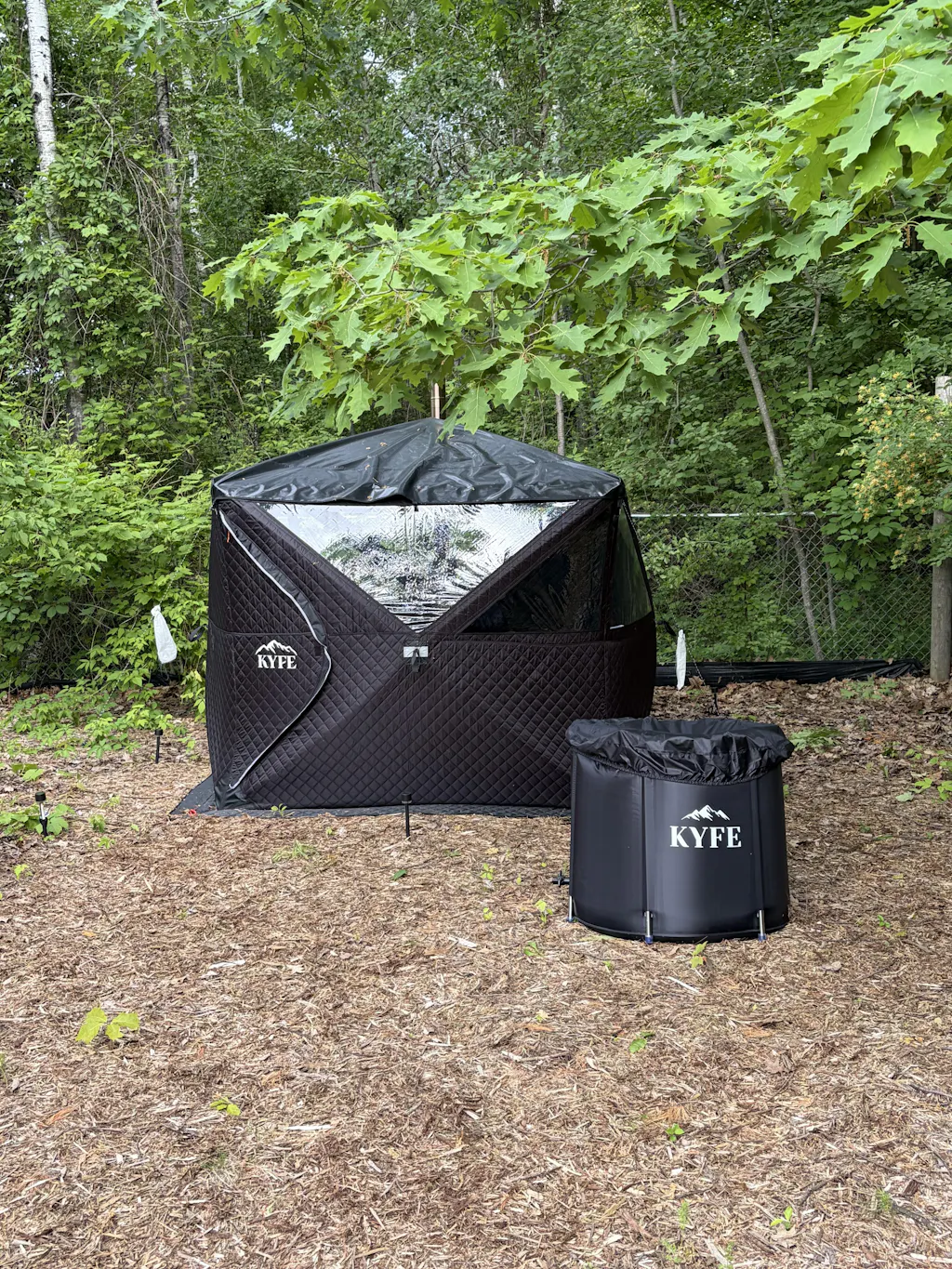
Introduce contrast therapy in this phase if you haven't already. The Kyfe cold plunge — included free with every sauna order — makes the sauna-to-cold transition accessible at home. Heat round, cold plunge for 2–3 minutes, return to sauna. The circulatory pump effect of alternating vasodilation and vasoconstriction produces recovery and performance benefits that heat alone doesn't match. Read more about the full protocol in our post on sauna and cold plunge for muscle recovery.
Weeks 11–12: Establishment Phase
Goal: Four sessions per week — the frequency the research rewards most strongly.
Temperature: Your preference in the 175–200°F range Session length: 15–20 minutes per round Rounds per session: 2–3 rounds Sessions per week: 4
By week twelve, sauna has stopped being a practice you're building and become a practice you simply have. Four sessions per week at operating temperature — with occasional contrast therapy, deliberate löyly, and consistent post-session recovery — is the protocol most directly associated with the strongest long-term health outcomes in the available research.
The 12-week journey from a nervous 8-minute first session to four confident weekly sessions at 200°F is more significant than most beginners expect when they start. You're not just more comfortable in the heat — your cardiovascular system has adapted, your stress response has improved, your recovery from training is faster, and your relationship with intentional discomfort has fundamentally changed.
That last point is worth naming. Regular sauna practice at genuine temperatures teaches you something about the relationship between voluntary challenge and reward that extends beyond the sauna. The same quality of mind that lets you sit comfortably in 190°F heat and breathe slowly applies elsewhere.
Safety Guidelines Every Beginner Should Follow
Safety isn't a footnote — it's the foundation of a sustainable practice. Here are the non-negotiables:
Always hydrate before and after. This cannot be overstated. Pre-session dehydration is the single most common cause of premature exits, lightheadedness, and negative experiences. 16–24oz before, another 16–24oz after. Electrolytes matter — coconut water, an electrolyte supplement, or a pinch of sea salt in water all replace what sweating removes.
Never use alcohol before or during a session. Alcohol impairs your body's ability to regulate core temperature and masks the signals that tell you to exit. This combination is genuinely dangerous in high heat. Wait until after and after you've rehydrated.
Exit immediately if you feel lightheaded, nauseous, or unwell. No exceptions. The session can continue after recovery. Pushing through these signals in a high-heat environment is dangerous.
Don't sauna immediately after intense training. Give your body 20–30 minutes to cool down and normalize heart rate before entering the sauna post-workout. You can read more about optimal timing in our post on sauna before or after gym.
Build up slowly. The protocol above exists for a reason. Skipping phases doesn't produce faster adaptation — it produces burnout and bad experiences that put people off a practice that could have been life-changing.
What to Do Inside the Sauna as a Beginner
Many first-time sauna users spend their sessions watching the clock. That's a sign the session hasn't found its rhythm yet. Here's what to focus on instead:
Breathe deliberately. Slow, deliberate nasal breathing in the sauna changes the experience completely. It activates the parasympathetic nervous system, makes the heat more tolerable, and produces the mental clarity that regular sauna users describe as one of the most valuable parts of the practice. Inhale for four counts, exhale for four counts. Repeat.
Sit still. Fidgeting and movement generate additional body heat and make the session harder. Find a comfortable position and commit to it. The stillness is part of the practice.
Don't bring your phone. The sauna is one of the few genuinely screen-free environments most people experience. That's not an inconvenience — it's the point. Twenty minutes without input is more valuable than most people realize until they've experienced it consistently.
Experiment with löyly. As you progress through the beginner protocol, gradually explore more active löyly — different pour sizes, different additives, different rhythms. The Kyfe Essential Oils Set of 3 is a great starting point for aromatherapy once you're comfortable with the basic heat experience.
For a full breakdown of what to do during sessions, read our post on 10 high-impact things to do inside your sauna.
Building the Habit: What Makes Beginners Stick With It
The sauna practices that last aren't the ones with the most aggressive protocols — they're the ones built around consistency and enjoyment. Here's what separates the beginners who are still using their sauna daily in year three from those who use it for a month and stop:
Same time, same days. The habit research is clear — routine beats willpower every time. Pick your three or four days and your time slot and protect them. Morning sessions before the day starts have the lowest cancellation rate. Read more about why in our post on why morning is the best time for sauna.
Make it enjoyable, not just beneficial. The health benefits are real but they're not what makes you show up on a cold Tuesday morning. The experience needs to feel good. Good löyly, your favorite music or podcast from outside the tent, a post-session ritual you look forward to — these are what sustain a practice over years.
Track your progress. Note session length, temperature, how you felt, what you noticed. Progress in sauna tolerance is real and measurable — seeing it documented builds motivation more effectively than abstract health goals.
Use the cold plunge. Beginners who pair their sauna with contrast therapy — even a cold shower when starting out — report dramatically higher session satisfaction and stick-to-itiveness than those who do heat alone. The post-contrast state of clarity and energy is highly motivating. It becomes something you look forward to rather than something you're doing for your health.
FAQs
How long should my first sauna session be? 8–10 minutes is the right starting point. This is long enough to begin experiencing the heat response without overwhelming your body's regulatory systems. Build from here over the 12-week protocol above.
What temperature should I start at? 150–165°F for your first few sessions. The Kyfe can reach 200°F but there's no benefit to pushing to maximum temperature before your body has adapted. Let the fire stabilize at a comfortable heat and build from there.
How will I know when I'm ready to increase duration or temperature? When a session at your current setting feels comfortable and enjoyable rather than challenging, you're ready to progress. That's the only signal you need. The protocol above gives approximate timelines but individual adaptation varies.
Is it normal to feel tired after a sauna session? Yes — especially in the first few weeks. The heat imposes a real cardiovascular demand and recovery follows. Most beginners experience a pleasant tiredness that transitions to post-session clarity over the following hour. If fatigue persists for several hours, reduce session length until your body adapts further.
Can I use the sauna every day as a beginner? Not recommended in the first four weeks. Daily use before adequate adaptation can accumulate fatigue rather than produce recovery. Follow the protocol — two sessions per week in weeks one and two, building to three and then four over the following weeks. Daily use is appropriate once heat tolerance is established.
What should I do if I feel dizzy inside the sauna? Exit immediately. Sit in fresh air. Drink water with electrolytes. Do not re-enter that session. Dizziness is a dehydration or heat overload signal — take it seriously. Your next session, reduce temperature or duration and ensure your pre-session hydration is better.
The Bottom Line
The sauna practice that produces real health outcomes over time is not built in one session or one week. It's built across months of consistent, progressive sessions that compound into something genuinely transformative — better cardiovascular health, faster recovery, deeper sleep, and a relationship with intentional discomfort that extends well beyond the tent.
The 12-week protocol above takes you from a first nervous session to four confident weekly sessions at full operating temperature. Follow it progressively, hydrate consistently, listen to your body, and give the practice time to become what it's capable of becoming.
Shop the Kyfe Portable Sauna Tent — everything included, free cold plunge with every order, ships in 1–2 days.
Portable Sauna Tent vs Sauna Barrel: Which Is Worth Your Money?